Showing posts with label task 1 insect. Show all posts

Sunday, 4 October 2015

Weekly Summary: 2

Choosing a silhouette:


It was time to narrow down my selection of silhouettes. I chose 5 based on their shapes, balance/proportions and how much they personally appeal to me because I think it's important to have an interest in your project if you expect to get the best results out of it. To help me decide on a silhouette to iterate, I wrote what it is about them that I like and what I could potentially do with them.


As a result, I chose the 4th silhouette because I know that I want to experiment with transparency and layering. The 2nd, 3rd and 5th silhouettes already have busy shapes and layering parts may over complicate them. In comparison to the first silhouette, the one I chose has a similar shape and style. However I think that the soft shape of the wings compliment the jointed parts of the insect and there's more option for me to experiment with it than the first silhouette.


Iterating the main body shape:


After deciding on my silhouette, I made quick iterations of the main body shape. I copied and lowered the opacity of my silhouette and painted over them. I kept it greyscale for now to focus on the design.


Iterating the pattern:


After looking at some patterns of insects online, I made the iterations shown above. I though it would be a waste of opportunity if I didn't give my insect any patterns because it has clear wings. I went with number 2 because I thought it looked cleaned yet organic at the same time.


Colour Palettes:


I looked online for some colour palettes that I liked because I'm not very good with colours. I am pleased with all of them but the last one appealed to me the most.


Wings Iteration 


Just before I stated my thumbnails, I saw some beautiful photos of insects with 'windows' in their wings. I thought it would be an interesting way of playing around with how I show the pattern on my insect's back. After trying some designs, I decided to stick with plain clear wings because I thought that pattern was enough.


Composition Thumbnails:


I want my insect to be incredibly tiny so I chose flowers that are relatively small. The first one a lavender, second one a daisy, third a forget me not and the last one a macro of a petal. I decided to go with the last one to emphasise the proportion of my insect.


Colour Thumbnails:


I played around with some colours because I still didn't have a clear picture of what i want in mind. I even changed the colour of my insect in the last two thumbnails to experiment. However, I decided to go with my 2nd design because I love forget me nots and I thought my insect could camouflage with the blue petals while also complimenting the yellow centre of the flower.


Final Piece:


The final piece took a long time to paint because I don't usually draw without outlines. However I was pleased with it because I was able to practice edge control and values. I think as I practice drawing without outlines, my process would be quicker and more efficient.

Wednesday, 30 September 2015

Research: Character Sheets

What are character sheets?

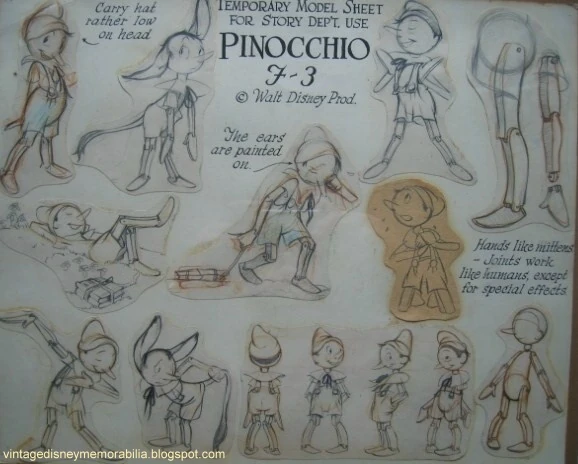
In games design, character sheets show the character's movements and interactions. It's suppose to give an impression of the character's personality.

Below: 
Temporary model sheet for Disney's version of Pinocchio and Model Sheet for Paperman's Meg


I got into art because of Disney model sheets. I think it's a privilege and a gift to be able to bring characters to life. While making character/model sheets, you can put yourself in the character's point of view and see the narrative in a different way.


My insect character sheet:


This character sheet took longer than i expected because not understanding how my insect's anatomy works frustrated me. It took a couple of attempts (with the image above showing an initial sketch) to come up with my character sheet. It was interesting to think of my insect moves because they don't necessarily have human characteristics. Below is my finalised character sheet and I gave my insect the name 'Cleatle' which is a portmanteau of the words clear and beetle. 


Disney, (2014). Blog Pinocchio model sheet. [image] Available at: http://vignette2.wikia.nocookie.net/disney/images/a/a5/Blog_Pinocchio_model_sheet.JPG/revision/latest?cb=20140619021141 [Accessed 30 Sep. 2015].


Disney, (2014). Model sheet for Paperman's Meg. [image] Available at: http://41.media.tumblr.com/3d81a11afdeb3d05dbe2c6611df345ba/tumblr_n0g4xm9T1M1t0xyebo2_500.jpg [Accessed 30 Sep. 2015].

Sunday, 27 September 2015

Weekly Summary: 1

BA1a Concept Art Brief: 


You will develop a series of images and designs for 3 different specifications to introduce you to new processes, tools and applications. Your focus is to iterate and improve your designs through silhouettes, thumbnails, studies and digital painting. You will be supported through workshops, lectures and tutorials throughout. 


Life Drawing:


The life drawing session was a great way for me to start working on my anatomy skills. I have participated in life drawing sessions in the past and have always been interested in it because I am drawn to character design. I think solid fundamental anatomy skills are essential to concept art. 


Silhouettes:

After being briefed I started creating my silhouettes (click link to see research post). As I explained on my post, I felt that creating thumbnails without some sort of plan would have resulted in me progressing very slowly with this task. By choosing to create an original non-fiction insect, I was able to create better and quicker thumbnails using alchemy. 

Additionally, I created 8 second thumbnails on Photoshop at the beginning but chose not to develop them as I feel that Alchemy is more suitable to use for this project. It was a great way to get the pre-conceived ideas out of my head so that I could make better designs. 


While making the silhouettes, I began asking myself if my designs are actually 'original'. There’s always been a grey area when it comes to ‘original’ designs. At first I was worried that my silhouettes are of insects that already exist. However I realised that it doesn’t really matter because as long as I’m creating content, I’m learning and developing as an artist. If my final design does end up being extremely similar to an existing insect, then I can just learn from it, possibly develop it and move on.


I think the only problem I encountered this week was time keeping. To solve this problem, I have created a loose plan that I will try to stick to next week in order to finish the project in time.


Friday, 25 September 2015

Research: Alchemy

After sketching some rough thumbnails on Photoshop, I decided to try Alchemy. As we were told, I found Alchemy hard to use. However after trying all the tools and practicing for a few minutes, I was able to draw silhouettes purposely. I thought I had a good variety of shapes and form although it did lead to some questions that I referenced in my previous blog post. It seemed like I could make an infinite amount of these silhouettes and the for the time were were given for this project. I needed a guideline to help me speed up my process while not compromising the quality of my work.


I've never drawn creatures in the past and silhouettes like the ones above made me feel confident because I thought I was stepping out of my comfort zone. Only after some reflection did I realise that i could take it further by choosing to make an original and non-fictional insect.


These are the silhouettes that I made after researching what insects are:


It clearly shows that practice is important because my second batch of silhouettes have more definition and better form that my first ones. I enjoyed layering the shapes by altering the transparency and using gradients to make some if the wings appear lighter. By using Alchemy, I was able to create quick thumbnails that I thought are perfect for the brief. I don't think I would have achieved the same effect on Photoshop and if I tried it would have taken me hours rather than minutes. Not having the option to undo was also helpful because it taught me to embrace accidental shapes and have it as a part of my work. It made me worry less about my preconceived notions because I was forced to adapt to unexpected strokes. 

Research: What are insects?

While creating my initial group of insects, I came to a realisation that I first need to decide what type of insect I want to make. I narrowed my options to three basic types:

  • Fictional: Any human made classification of insects do not matter as long as it resembles an insect (means greater boundaries in terms of narrative and how crazy it could look) 
  • Non-fictional: Following the description of what insects are, 3 pairs of legs, etc. (doing more research but it would make the design more believable) 
  • Hybrid- combining two or more types of existing insects to create a new type of insect (less work but also less challenge and chance to develop skills) 


After deciding to design a non-fictional insect, I researched the definition of insects to help build a specification for my design.Through online resources, I found that insects have the following characteristics:
  • invertebrate 
  • in the arthropod phylum (they have a segmented body, exoskeleton and joined appendages) 
  • 3 parts to their body (head thorax, abdomen) 
  • 3 pairs of jointed legs 
  • compound eyes (thousands of units which allows for wider angles, more movement and light) 
  • one pair of antennae 
  • most have wings 


What interested me the most is the difference between humans and insects. Normally I would never think about the anatomy of other creatures. I think it's fascinating that insects are designed to have tough exoskeletons to protect their insides. Furthermore, I am interested in insects with specific evolutionary adaptations like the lichen-coloured katydid that can blend in with it's surroundings incredibly well. My aim is to design an insect that has a fascinating quality that gives it either a defensive or offensive advantage.